Will Viktor Orbán's illiberal system fall? A crucial campaign period begins in Hungary

The political situation in Hungary is extremely tense, with the 2026 election campaign officially kicking off last Saturday. Parliamentary elections will be held in the country on April 12, which will determine if Viktor Orbán's sixteen-year-long rule will continue or whether Fidesz's illiberal government will be interrupted.
The last time such anticipation preceded an upcoming election was perhaps in 2002, when more than 73 percent of eligible voters participated in the second round. Viktor Orbán and Fidesz were in power at that time as well, but in the end, they lost to a coalition of the socialist MSZP and the liberal SZDSZ parties.
After two terms in opposition, Viktor Orbán regained power in 2010 and, shortly thereafter, with a two-thirds majority in Parliament, introduced a single-round election system in Hungary. There is every chance that this year's single-round election will break the 24-year-old turnout record, with even more people going to the polls than in the second round in 2002.
How did we get here?
Although the campaign has officially begun only last Saturday, Hungary has been buzzing with campaign fever for at least a year. This is due to the fact that the political race is much more evenly matched than in previous elections: after sixteen years, it now seems more likely than ever that the two-thirds majority governance of Viktor Orbán and Fidesz will come to an end.
Although there are still many uncertainties, independent pollsters are measuring the challenger Tisza party's lead. In early February, the 21 Research Center measured a 16-point lead for the opposition among certain voters, while Medián recorded a 12-point lead two weeks earlier. This seems like a significant lead, but the race is far from over: according to the polls, the same number of voters expect Fidesz to win as those who expect the opposition’s victory.
In the two years since February 2024, i.e. the presidential pardon case – the resignation of President Katalin Novák and Fidesz MEP and former Minister of Justice Judit Varga – the map of Hungarian party politics has been completely redrawn. The opposition parties that won seats in the previous election – such as the liberal Momentum, the socialist MSZP (Hungarian Socialist Party), and the green LMP (Politics Can Be Different) party – have completely crumbled, and their followers have started to support the Tisza party movement led by Péter Magyar, which became stronger and stronger over time.
Péter Magyar, who held several different positions in state-owned companies under previous Fidesz governments, became known in the country after he began publicly criticizing the government following the resignation of his wife, Judit Varga. There haven’t really been any examples of such defections in the past 16 years. Magyar not only posed a new challenge to Fidesz in a sense that he came from within party circles and knew how the system worked, but he also consistently articulated right-wing messages. While he primarily criticized the government for corruption and neglect of public services, he began to develop conservative rhetoric similar to that of Fidesz on issues such as migration and national policy. In the 2024 European Parliamentary elections, Tisza was by far the strongest opposition force: with more than 1.3 million votes, they achieved a result of nearly 30 percent and won seven seats (out of Hungary’s 21) in the EP. A widespread mood of protest developed in the country, and within a year, Tisza managed to become the only possible way to achieve a change of government in Hungary.

Magyar's greatest achievement was that he was able to push Viktor Orbán off his own track. His large-scale events, tours around the country, and politics based on rituals and symbols were reminiscent of the Fidesz's 2002 campaign, with the not insignificant difference that Tisza was forced to take on the current government without resources or organizational background. Fidesz has yet to find an antidote to Magyar's aggressive and confident social media presence: the smear campaigns that the government has used to keep its opponents under control for several terms seem to have no effect on the Tisza leader.
In the fall of 2024, something happened, that has been unprecedented for seventeen years: independent pollsters no longer measured Fidesz as the most popular party in the country, Tisza took over. Besides the two dominant parties, currently the leftist-liberal DK (Democratic Coalition) and the far-right Mi Hazánk (Our Homeland) Movement, which is close to Fidesz, have a chance of getting into parliament, but the former seems unlikely. There is a serious possibility that the Hungarian left will be completely crushed, and a purely right-wing parliament will be formed in Hungary.
Signs of decline
By 2025, the Hungarian domestic political climate had changed significantly: Fidesz, which had been dominant for several cycles and controlled every narrative, made more and more missteps. Not only did economic results fall short, but Viktor Orbán also made a number of political mistakes that had been rare in the previous fifteen years.
At the beginning of the year 2025, the Prime Minister predicted a spectacular economic boom (he used the expression flying start, to be precise), but the results fell far short of expectations: the Hungarian economy grew by a mere 0.3 percent last year. Referring to the need to protect sovereignty, Fidesz threatened the independent press and civil society organizations with a so-called transparency law, but was ultimately forced to back down. The Prime Minister personally sent a message to the organizers of the Budapest Pride that they should not even bother with the organization of the event, and yet, the largest parade ever took place in June on the streets of Budapest. Viktor Orbán stood in support of the anti-Hungarian presidential candidate George Simion, who ultimately lost the Romanian presidential election.
These various issues piled up and eroded Fidesz's image. The myth of Viktor Orbán'sinvincibility and infallibility was shaken. For more than a decade, the Prime Minister had built up an image of himself being at least one step ahead of the others and having a better understanding of the processes worth paying attention to in international politics. This image has gradually become blurred.
Recognizing the changed playing field, the Prime Minister and his staff switched to more intensive social media communication. Since last spring, Orbán has been giving several interviews a week, including to more or less independent channels, he has increased his social media activity through engaging more with voters, and has surrounded himself with new celebrities. He founded the so-called Fight Club and the Digital Civic Circles, both of them two top-down movements designed to boost the social media activity of his voter base.
Orbán and his allies have put all their eggs in the Ukrainian basket: all government channels are trumpeting that Brussels and Kyiv want to drag Hungary into the Russian-Ukrainian war, and the country must stay out of it. This is not so surprising, given that they already won the 2022 elections with similar rhetorics, but by now the fear-mongering rhetoric and anti-Ukrainian incitement have reached a new level. Fidesz is rapidly producing cheap yet shocking media content generated by artificial intelligence – today the rhetoric has reached the point where they are basically saying that if Tisza wins, your father will be shot in the head.
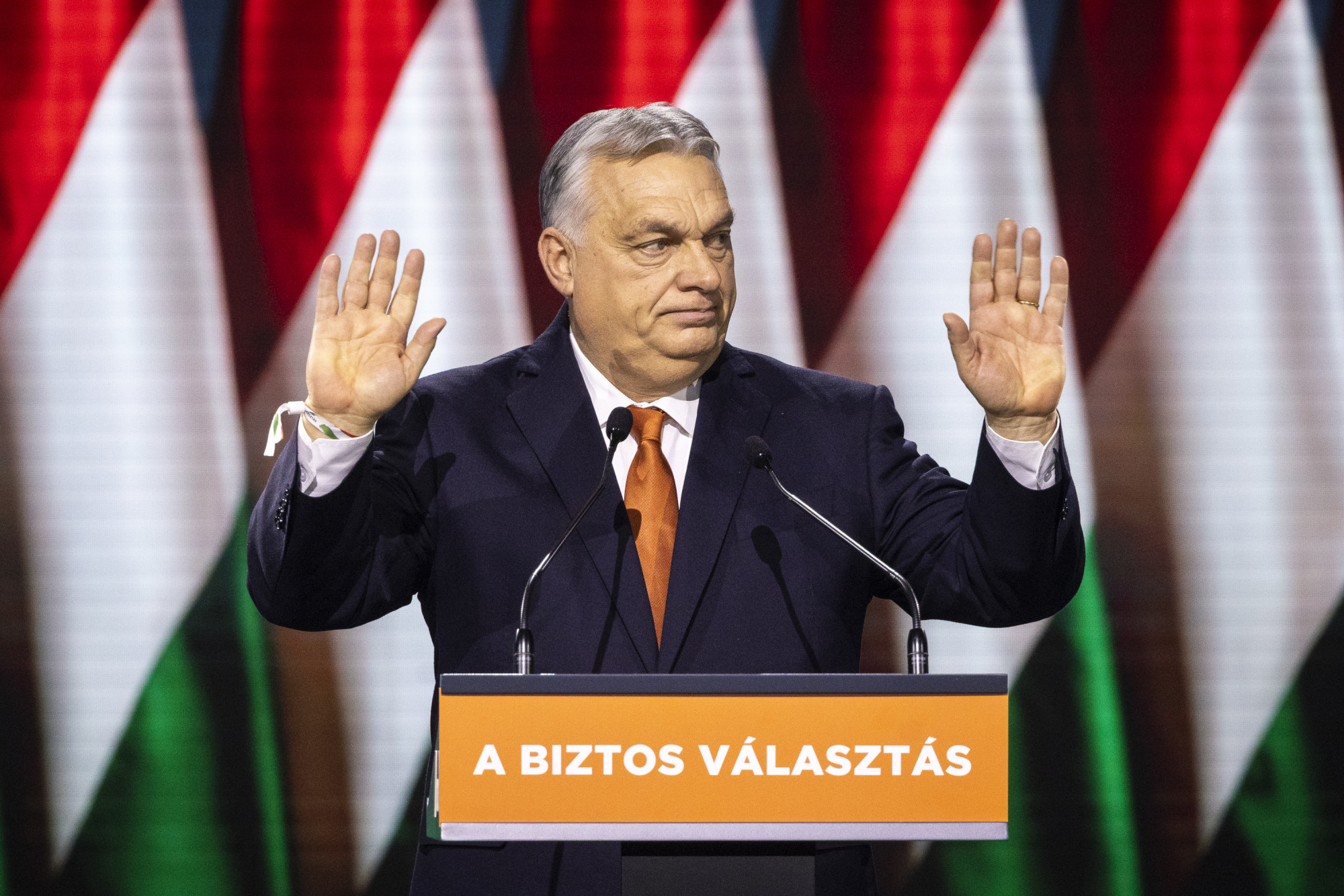
Fidesz, campaigning under the slogan "the safe bet"; is telling its voters that only Orbán can protect the country from the dangers of war. In addition, they have announced a series of welfare measures, ranging from tax exemptions for mothers with multiple children to a preferential home loan program. Still, these measures have been unable to significantly halt Tisza's rise in popularity. In the second half of the year 2025, several cases of abuse in the Hungarian child protection system came to light one after another. Magyar, who continued to resist the attacks against him, kept the government under constant pressure by keeping these delicate issues on the agenda. In mid-December, as a result of these scandals, Magyar and his supporters were able to mobilize tens of thousands of people to protest in Budapest.
Although the balance seems to be tipping towards the opposition, it would be a mistake to assume that the election is already decided or that there is a clear favourite in the race. Viktor Orbán should never be underestimated. In 2002, when he ultimately lost, in just two weeks he came within a hair's breadth of turning around an election that seemed to be already decided. The most important period of the election campaign is yet to come. And in many respects, Tisza has to play uphill.
Fidesz enjoys overwhelming control of resources
Viktor Orbán has been working with a well-established, tried-and-tested team and methods for almost twenty years; his office constantly monitors voters's; political preferences and existential fears, and often adjusts its policies accordingly. The campaign team is supported by a government apparatus and a media empire built with hundreds of billions of state funds.
In addition to conservative newspapers, the country's largest commercial television station (TV2) and the once-independent online media flagship outlets Index and Origo now serve Fidesz's communication and political goals. Moreover, the two biggest tabloid journals of Hungary (Blikk and Bors) are also controlled by the party. Through the Central European Press and Media Foundation (KESMA), there are more than 500 media outlets under the direct control of the government. As part of this, Fidesz exercises total influence over the rural newspaper market covering the public media outside Budapest. This centrally controlled media empire, with government-backed influencers and opinion leaders, is the government's main weapon, complemented by the public media, which operates under complete political control with a budget of 140 billion forints.
In contrast, Péter Magyar, can rely mainly on his intense social media presence and the keen interest of the independent press – and he indeed builds his communication strategy on this. In social media interactions, Tisza spectacularly outperformed Fidesz, thanks in part to the fact that, after Google, Meta also announced last summer that it would no longer run political, election-related or socio-political ads in the European Union. The withdrawal of Facebook ads is a serious blow for the government. The ruling party, which has an enormous resource advantage, was trying to balance these new unfavourable conditions by abolishing the upper limit on election campaign spending last summer. This allows Fidesz to use its resources even more unrestrainedly in the election campaign than before.
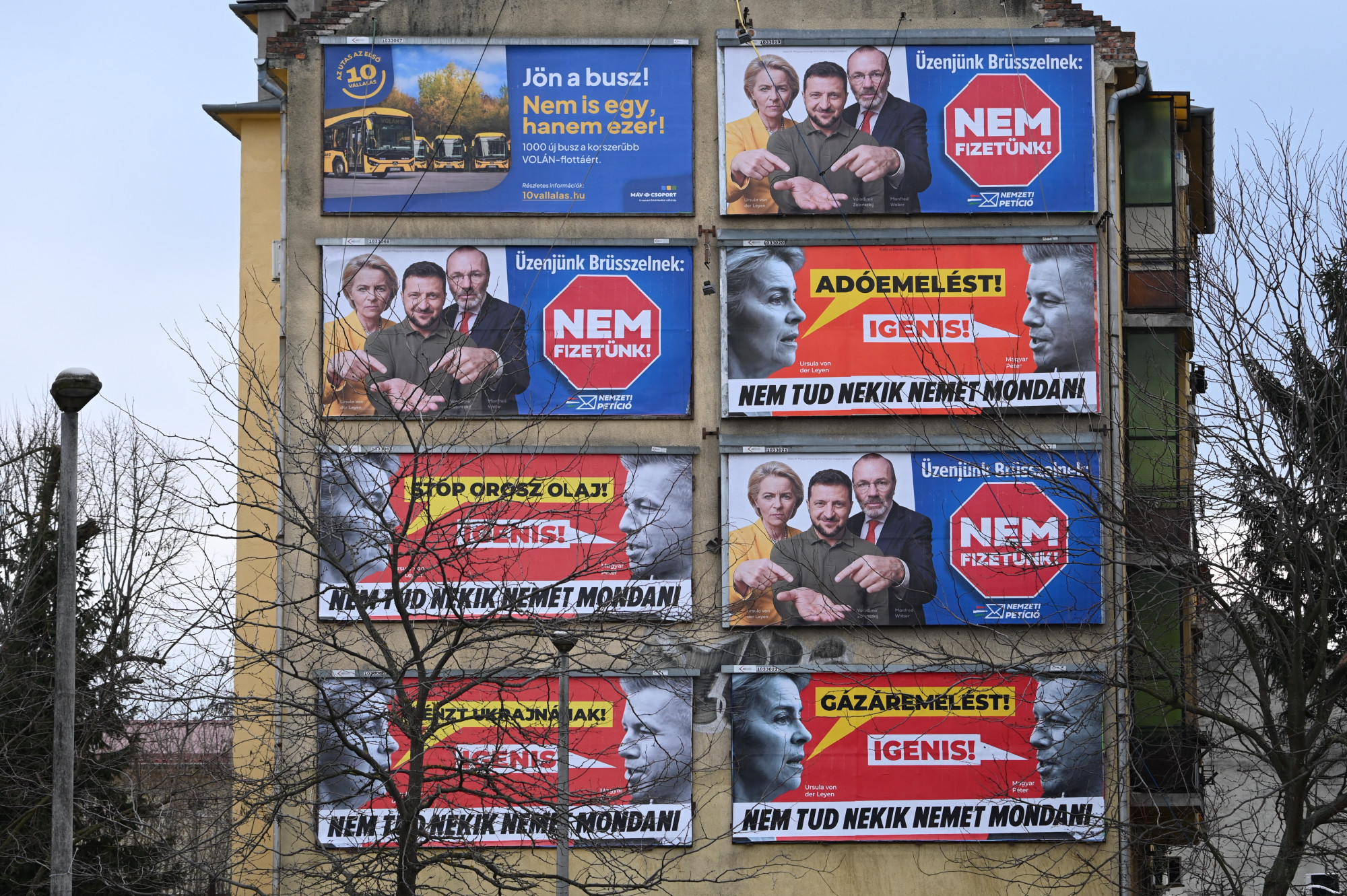
Walking through the streets of Budapest or other large cities, one encounters almost nothing but Fidesz or government-related billboards. In 2022, the government side had eight times more financial resources than the opposition for advertising in public spaces. They achieved this, in addition to party communications, by subsuming government information forums, that originally served the purpose of informing the public about current social issues, to further their own political goals. Moreover, they provided huge sums of money to pseudo-civil society organizations (primarily the Civil Cooperation Forum – CÖF) that supported their campaign communication. Their dominance will be even more striking this year, as the Tisza Party announced that it will not advertise on billboards at all, due to a lack of funds.
Even so, this is only a fraction of the state resources that the government has recently mobilized for its own re-election. The government also keeps public opinion under constant pressure: it publishes characteristic, blue-coloured information billboards and public announcements, conducts "national consultations"; (opinion surveys sent out via letters to citizens) that consistently build on Fidesz's communication narrative, whether on immigration, war, or gender issues. Since the 2022 election alone, the cabinet has spent 225 billion forints on government communications.
National consultations based on questionnaire surveys have also helped to keep databases up to date for several cycles. Since the second half of the 2000s, Fidesz has been systematically building and using such databases on voters, which deepen the party's roots and help activists in their work during campaign periods. The big question is the state of the party organization itself and to what extent Fidesz's activist network can be mobilized: Orbán had repeatedly complained during the campaign that mobilization was not going well for them so far.
But Fidesz also systematically uses various organs of the state apparatus for party political purposes. The State Audit Office, which has consistently turned a blind eye to the financing and hidden campaign spending of pro-government pseudo-civil society organizations, threatened and fined the opposition hundreds of millions of forints in both the 2018 and 2022 campaigns. The media authority never raised its voice during any campaign about the state financing of centrally edited government newspapers. At some point, it was also common practice to have municipal officials and public workers make phone calls to the Fidesz databases. The party and the state have become so intertwined that it now seems almost natural (even though it is illegal) for ministers and state secretaries to spend their working hours campaigning for the party and using their official resources to do so.
The government accuses the opposition of treason, while the opposition threatens the government with prison, so the stakes could not be higher. The two sides agree on only one thing, which is that this election will have serious consequences on the fate of Hungary. Many people view this election as a chance to change the country, and if there is no change now, they will emigrate. Fidesz, on the other hand, is saying that if the government is replaced, Hungary will go to war.
In the finish line, all means will be used. On February 10, a website went live suggesting that Péter Magyar had been tricked by the secret services and filmed in an intimate situation. Magyar admitted that his ex-girlfriend had seduced him at a party where drugs were also being used, but the recording has not yet been made public. Although Fidesz denies any involvement in the affair, few believe this, given the government's political practices, the direct supervision of the secret services, and the timing of the scandal. It is not yet clear whether the story will escalate, but if it does, it could be a turning point in the campaign.
Nevertheless, the real dilemma is not whether the recording will be made public and how the electorate will react to it, but whether – in this combative atmosphere – it will be possible to achieve a result that the losing side will accept peacefully.
The Hungariam version of the article was published on February 21 on 444.
Translated by Veronika Czina.
